LED Headlight Manufacturer: What Top B2B Buyers Check Before Ordering
An LED headlight manufacturer is the company that owns the stations where light gets built. That means the line mounting chips onto boards, the benches where drivers are soldered and calibrated, and the racks where finished lamps are aged before boxing. That single sentence is the test, and most supplier pages fail it without noticing.
Trading companies use the word freely, because it reads better than distributor. The checks below are the ones that separate a factory floor from a well-designed PDF, in the order a buyer can actually run them.
What a Real LED Headlight Manufacturer Controls
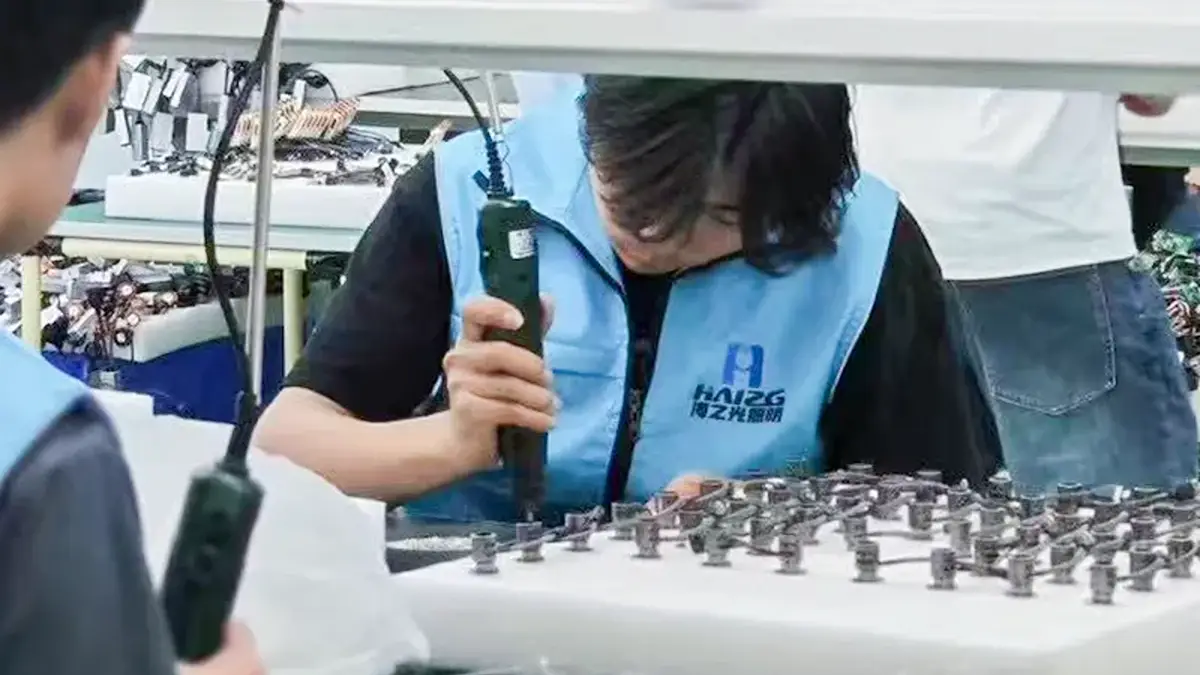
A manufacturer owns process control, so chip mounting, driver assembly, calibration and aging happen under one roof.
Four roles sit between a design and a delivered carton, and each fails in a different way. A brand owner commissions parts and markets them. A manufacturer makes them. An assembler buys boards and chips from other suppliers, fits them into a housing, and calls the result its own design. A trader lists everything and owns nothing.
None of those is automatically wrong. An assembler can still ship a good bulb when its incoming inspection is strict. Trouble starts when a buyer cannot tell which role answers the email, because the warranty claim, the tooling file and the defect rate all land on whoever controls the line.
Ask one question that settles it: which stations does this company own, and can I watch them run my product? A real answer names equipment and a sequence. A marketing answer names adjectives.
| Role | What they typically own | The question that exposes it |
|---|---|---|
| Brand owner | Design brief, tooling payments, marketing assets | Which factory name appears on the customs paperwork? |
| Manufacturer | Mounting line, driver assembly, aging racks, test bench | Which station checks the beam before boxing? |
| Assembler | Housing, final assembly, purchased boards and chips | Who supplies your boards, and what do you inspect on arrival? |
| Trader | A listing, a payment channel, a forwarding account | Can I see the line running on a live video call today? |
A factory page worth reading answers in a station-by-station voice. Ours names a 5,000-square-meter plant in Guangzhou with eight dedicated lines, and states that driver boards are built in house rather than outsourced, on the manufacturing page. Treat any claim of that kind as a checklist item to verify, not a conclusion to accept.
Inside the Production Line From SMT to Aging
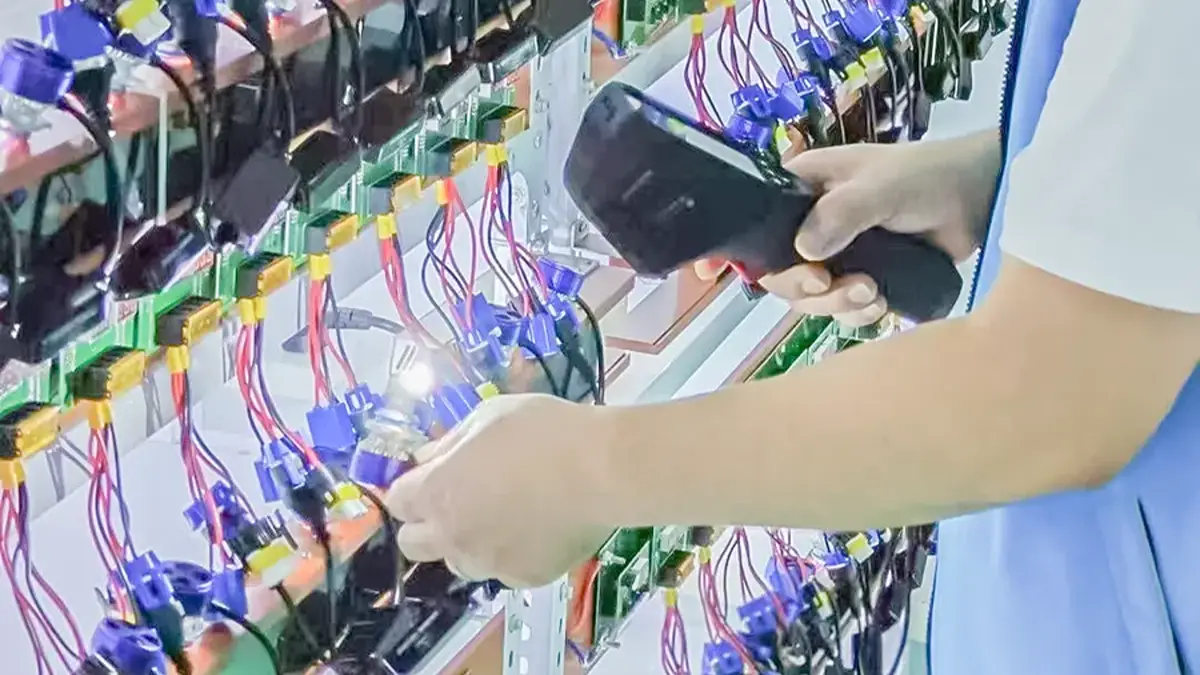
Four stations decide quality before a bulb is boxed, and a buyer can ask about each one by name.
This is what a car bulb line looks like when it is documented honestly. A factory that skips a step in its own description is telling you where its field failures come from.
Station one: incoming inspection
Chips, driver components, aluminum housings and copper substrates arrive from different suppliers, and a batch is only as strong as the weakest of them. Ask what gets checked on arrival and with which instrument. Those four inputs decide whether a bulb survives its first winter, so a line that inspects only finished lamps is guessing.
Station two: chip mounting and reflow
Surface-mount technology places chips onto a board in a printed pattern, then a reflow oven solders them in one pass. The profile that oven runs matters more than the brand of machine standing in it. Ask for the reflow profile and whether boards pass optical inspection after soldering. A line that runs one profile across every board design has tuned nothing.
Station three: assembly, soldering and calibration
Boards go into housings, heat sinks and lens assemblies, and those joints are where warranty claims are born. Semi-automated soldering stations and a calibration step for optical and thermal output are the marks of a serious line. Ask what gets calibrated, against which reference sample, and what happens to a unit that misses.
Station four: aging and end of line
Aging means running a finished lamp hot, at higher current than a car will ever supply, for hours at a stretch. Weak joints, marginal chips and thin driver capacitors fail there rather than on a highway at 70 mph. Our line runs high-voltage constant-current aging on racks under a full inspection protocol, with integrating spheres and thermal chambers on the measurement side.
Then test that description on a call. Ask for a video walk of the aging room during a running shift, on a date inside two weeks, with no preparation. Plants with racks in operation say yes, and the delay is usually scheduling rather than refusal.
Cooling and Driver Design Define Product Life
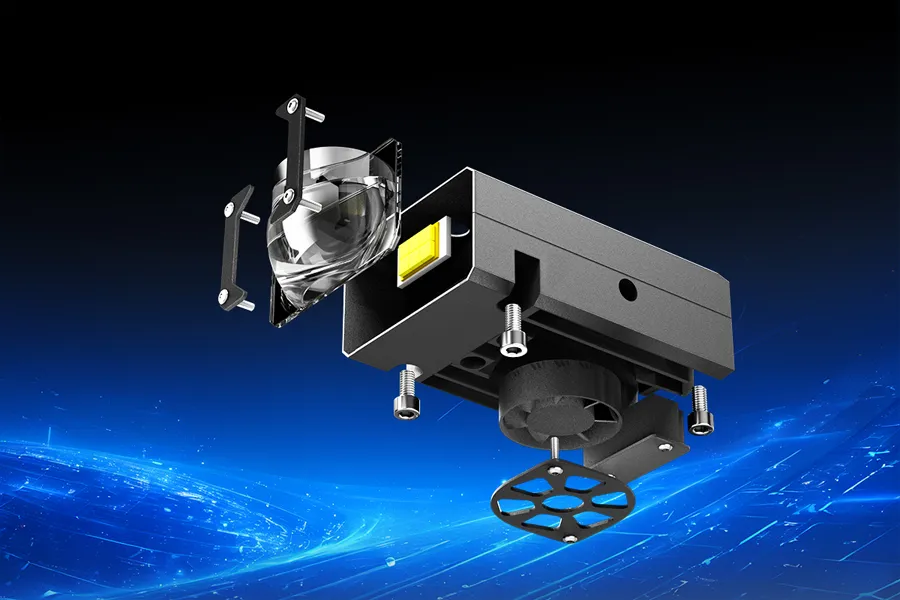
An LED bulb dies of heat rather than of hours, so the thermal path and the driver set real service life.
A chip converts only part of its input power into light. The remainder becomes heat at the junction, and junction temperature drives both lumen depreciation and how fast a solder joint creeps. That is why a specification quoting wattage with no description of the thermal path is half a sentence.
Ask which route the heat takes: copper core board, heat pipes, braided straps, a fan, or a combination. Our car LED headlight lineup lists the route model by model, from one to eight graphene-coated copper tubes with thickened copper substrates and dual-temperature control. The tube count matters less than the question behind it: what does the factory measure to prove heat reaches the sink instead of the chip?
For the driver, ask three things: input voltage range, behavior at over-temperature, and how the bulb reports itself to a vehicle with lamp-fault monitoring. Automotive electrical systems swing well outside 12 volts, and modern vehicles watch current draw for burned-out bulbs. A driver that ignores either will throw a code or dim early.
Next, check the arithmetic behind any brightness claim. Datasheet efficacy for automotive chip-scale packages is measured at low current and controlled temperature. That range sits around 100 to 150 lumens per watt, before optics and thermal derating take their share. A listing that advertises 200 lumens per watt for a finished bulb is quoting a bench number. Importers who repeat that number to their own retail customers inherit the returns.
Brightness is not the same thing as a usable beam. Independent researchers measure how far light reaches on five approaches. Their threshold is 5 lux at ten inches above the ground, and glare for oncoming drivers is measured separately at three feet seven inches. The full method is published by the Insurance Institute for Highway Safety. Ask your supplier for a photometric graph rather than a lumen figure, and look for a sharp, level cutoff line.
A bulb that throws a large labeled output into an uncontrolled pattern will dazzle oncoming traffic and fail a vehicle safety inspection. Fitment depth belongs in the same conversation. Ask which vehicle models a given bulb is confirmed against, and request the list in writing, because a universal claim usually means no fitment work was done.
Certifications That Separate Real Factories From Traders
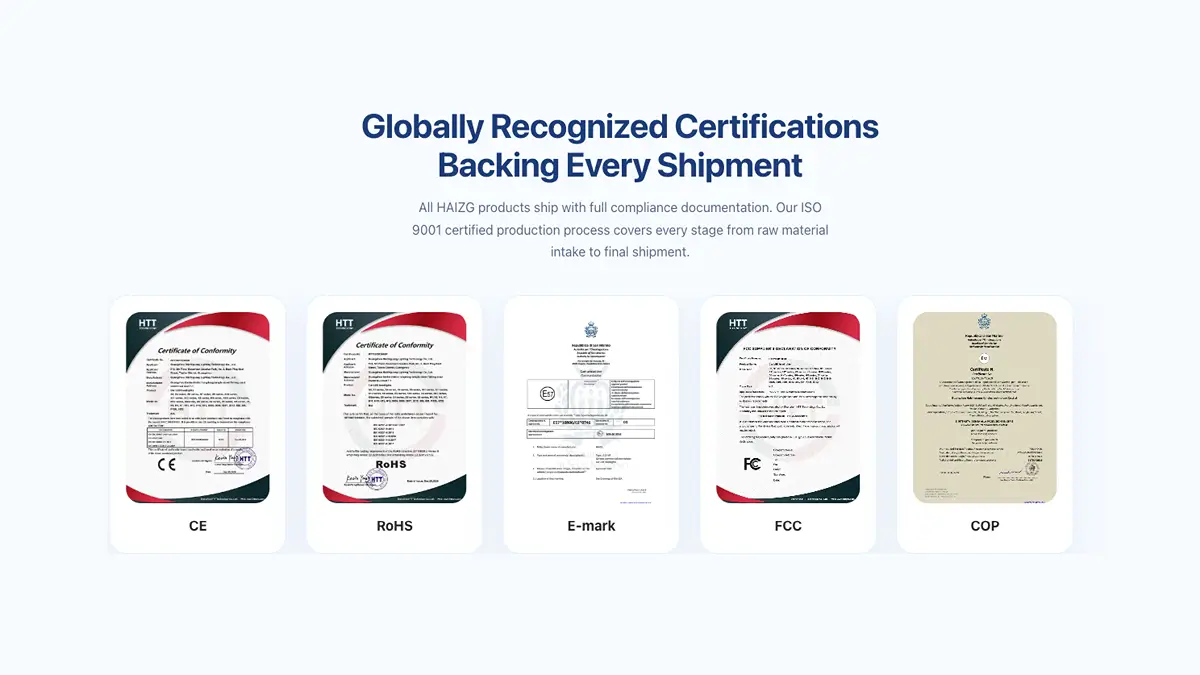
A certificate is worth only the number, scope and expiry printed on it, and all three are checkable in minutes.
For the United States market, the governing rule is Federal Motor Vehicle Safety Standard 108. It covers lamps, reflective devices and associated equipment, and it requires the lens of each replacement headlamp and each beam contributor to carry the symbol DOT. The text is public in the electronic Code of Federal Regulations. Ask which section a report cites, then check that the marking on the physical sample matches the paperwork.
For Europe, buyers get careless here in a way that costs money. Look for an approval number and the regulation it belongs to, then confirm that the number appears on a report naming that exact model. A page that lists dozens of standards without one verifiable number is a marketing page, and a buyer cannot clear a shipment on marketing.
Then look at the factory’s own quality system. ISO 9001 documents a management system for a named site. IATF 16949 is the automotive version, built on the same base with extra requirements for traceability and for production of safety-related parts. Our plant carries an ISO 9001 certificate. Ask for the file, read the site address printed on it, and read the expiry date. A certificate issued to a trading company at an office address is not a factory certificate.
For component-level life claims, ask which LM-80 data the chip supplier provides. The projection method built on that data caps extrapolation at six times the tested hours, so a six-thousand-hour test supports a projection to 36,000 hours and nothing longer. A supplier working to that limit can usually name the test lab behind the data.
Our second guide covers this ground from the other direction, with the document requests that expose a middleman: how to verify a real factory rather than a trader.
OEM vs ODM Capability Checklist
OEM puts your label on a finished design, ODM changes the design, and the two differ in who pays and who owns.
Quotations use these words interchangeably, and the difference is expensive. OEM means your brand on a design the factory already owns. ODM means the factory develops toward your brief, which pulls in optics, housing, thermal design and sometimes approval work.
| Question | OEM program | ODM program |
|---|---|---|
| Who owns the design files? | The factory, unchanged | Decide in writing before any tooling payment |
| What changes on the product? | Logo, shell color, confezione, label artwork | Optics, housing, driver tuning, sometimes beam |
| Who pays for tooling? | Nobody, since the design already exists | You fund the mold, so fix file ownership first |
| What must you control? | Artwork proofs and carton barcodes | Specification, first-article sign-off, approval scope |
| Who carries a defect claim? | The factory, inside the agreed warranty | Depends on whose specification failed |
Ask for a capability page before you ask for a price. The split that matters is between logo and packaging work on one side and optical or structural development on the other, because that is where a mold enters the conversation. If a factory promises full development but cannot name who draws the lens, it is buying that service from someone else and adding a margin to it.
How to Run a Manufacturer Trial Order
A trial order tests paperwork as much as hardware, and the cheapest one starts from a written specification.
Run it in five steps and keep every step on paper.
- Write the specification first. Base types, voltage window, target wattage, color temperature, connector, confezione, and the market the goods enter. A factory cannot misread a document that leaves nothing to infer.
- Order samples against that document. Ask for a dispatch date in writing before the sample ships. Compare what arrives with your own sheet rather than with the previous supplier’s claim.
- Fix four commercial terms in writing. Deposit and balance split, delivery term with a named port, warranty length, and how sample fees are treated on the first bulk order.
- Put the inspection standard into the purchase order. Sampling level, what counts as a cosmetic defect, and who pays for rework or replacement.
- Ship a pilot quantity and test it as a customer would. Fit samples in three vehicle models, watch for fault messages, and log output after a week of daily use.
Payment structure carries more risk than most first-time importers expect. Wire to a company account rather than a personal one, and confirm the beneficiary name matches the certificate and the business license. Split the payment so a real balance survives until you have inspected finished goods. Refuse any request to send money to a different bank account partway through production, a common failure mode in cross-border lighting trade.
Timelines are where a factory proves it is one. Our published ladder has four rungs. Stock samples ship the same day, stock bulk runs seven to ten days, and an OEM batch takes twenty to twenty-five days after artwork approval. Deep development work runs six to eight weeks. Ask which rung your order falls under, in writing, and what would change the answer.
Why Guangzhou Is the LED Headlight Hub
The Pearl River Delta shortens every loop a bulb needs, from chip to mold to port, and that speed is real.
An automotive LED bulb is a supply-chain product before it is an electronics product. It needs chips, driver components, extruded and die-cast aluminum, molded lens assemblies, bare boards, and printed cartons, and no single plant makes all of them. The Pearl River Delta puts most of those suppliers inside one regional economy, which is why so many headlight brands are assembled within reach of Guangzhou.
For a buyer, the cluster buys three things. It buys iteration speed when a lens needs a second revision, spare-parts depth when a supplier changes a driver component, and short inland haulage to the export ports. It does not buy quality. The same region holds excellent plants and workshops that rebox imported bulbs, and the address alone will not tell you which you found.
Compare the registered address on the business license with the address on the certificate and with the gate you actually visit. Our own address list shows that shape, with sales in Tianhe district and fabrication in Zengcheng, an outer district. Ask to see the plant at that address on a live call during a shift.
Sourcing strategy sits on top of that map rather than inside it. Our comparison of the ten largest LED headlight suppliers worldwide covers who to shortlist once the factory question is settled.
Frequently Asked Questions About Manufacturers
What does an LED headlight manufacturer actually make?
Usually the light engine rather than the whole headlamp. An LED headlight manufacturer mounts chips onto boards, builds or programs the driver, assembles the thermal system, calibrates the beam, and ages finished units. Housings and lenses may be made in house or bought to a drawing. What matters is ownership of the stations where those steps happen.
Do LED headlight manufacturers offer private label?
Most factories in this category do, and the range is wider than buyers expect: laser engraving on the shell, custom color temperature, branded cartons, inserts and barcodes. Confirm the artwork format they accept and who pays for a printing plate. Ask whether the same private label is already on the market, since an exclusive arrangement belongs in the order.
How long does LED headlight manufacturing take?
Four bands cover most orders. Stock samples ship the same day, and stock bulk runs seven to ten days. An OEM batch takes twenty to twenty-five days after artwork approval, while deep development work runs six to eight weeks. Those clocks start when the specification is frozen, not when the inquiry lands.
What is an aging test for LED headlights?
Finished lamps run hot, at more than their rated current, for hours before boxing. Marginal solder joints, weak chips and thin capacitors fail on the rack instead of in a customer’s vehicle. Ask for duration, current and pass criteria in writing, and ask whether aging covers every unit or a sampled batch. Full inspection means something different in each case.
Are Chinese LED headlight manufacturers ISO certified?
Many hold ISO 9001, and some automotive suppliers hold the stricter IATF 16949. The certificate only helps when it names the plant that makes your parts, so request the file and read the site address and expiry date. A trading company certificate at an office address says nothing about production control.