Fabricante de lentes de projetor bi-LED: Guia de seleção de comprador B2B
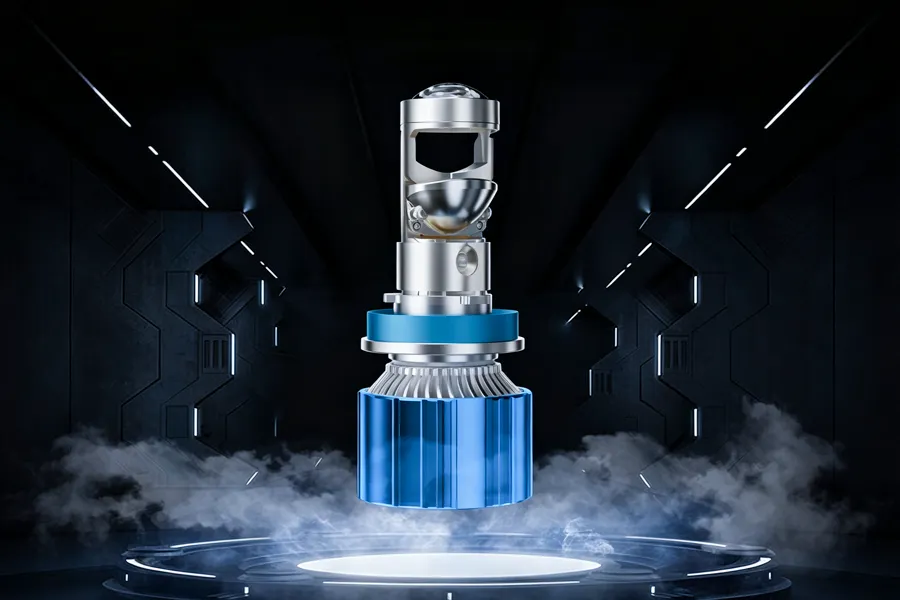
A bi-LED projector lens is one LED source inside one optical module that produces both the low beam and the high beam. A shield moves across the light path to choose the pattern. That single fact explains why a lens module behaves nothing like a bulb dropped into a reflector bowl.
Buyers comparing a bi-LED projector lens manufacturer usually get a sheet with two numbers on it: lumens and watts. Neither number describes a beam. This guide reads the lens the way a retrofit shop reads it, at the cutoff line, at the shutter, at the heat sink and at the bracket.
What a Bi-LED Projector Lens Actually Does
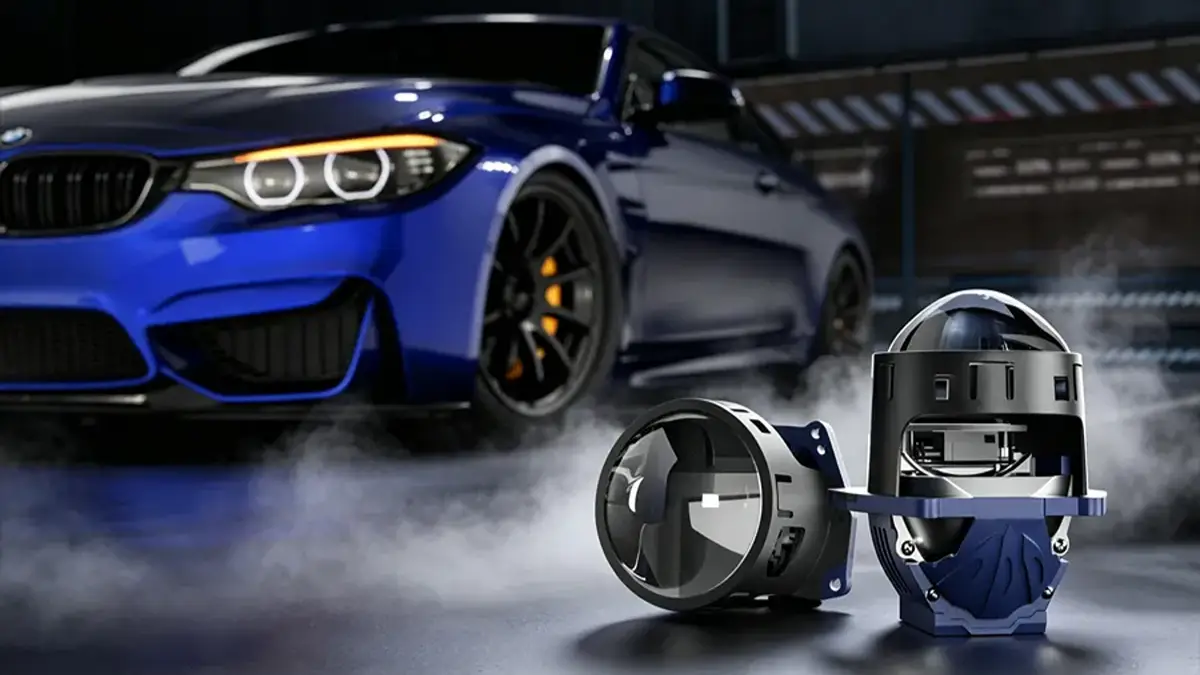
One source, one module, two beam patterns, and a moving shield does the switching.
The prefix bi means two. An LED chip assembly sits at the working point of a reflector cup, and a projection lens sits in front of both. Low and high beam come from the same optics.
The US safety standard already has a name for the object. Federal motor vehicle safety standard 108 defines a beam contributor as an indivisible optical assembly including a lens, a reflector and a light source. It forms part of an integral beam system and contributes only a portion of a headlamp beam.
A bi-LED projector lens manufacturer sells you that contributor, not a headlamp. Engineers design it to sit beside a second cup or module, and its published figures describe a share of a system.
Demand grows because the halogen housings these modules replace are still on the road. A workshop that keeps the original shell and fits a lens inside it sells a visible upgrade a full headlamp swap cannot price. Our published lens range runs from 1.5 inch to 3.0 inch and 40W to 130W. What costs a shop money is a glare call from an oncoming driver, far more often than a complaint about a dark road.
Reflector Cup Design Sets the Cutoff Line
Ask for a cutoff photograph on a wall at a stated distance before you talk price.
Three parts make the pattern. The cup collects light from the chip and sends it forward. The lens flattens the beam and throws it onto the road. The edge of the shield cuts the top of that beam, and that cut is what an oncoming driver reads as comfort or as glare.
The same section defines what the two beams are for. A lower beam illuminates the road ahead when the vehicle is meeting or closely following another. An upper beam serves distance and is for use when not meeting other traffic. A cutoff exists because the low beam has a duty to stop somewhere.
Cup count is where a spec sheet starts to mean something. Our F5 lens page names a main and a secondary reflector cup. It claims the pair lifts brightness in the center of the beam and reduces the light and dark breaks on the surface. The F3 page describes the same dual-cup idea with an enlarged high-beam reflector.
Glass matters next. The F5 table names high-boron silicon with high transmittance, and the 2.5 inch page describes composite nano optical lenses. Ask which material sits in the module you are quoting, and insist on a material name rather than a marketing word.
A lumen figure on a module answers a narrower question than buyers assume. Where a headlamp uses more than one beam contributor for a lower beam, the federal rule lets each contributor meet only its allocated share of the requirement. A per-module number is a component figure, not a headlamp figure.
Track measurement sits a third step away. The IIHS headlight test method drives a vehicle over five approaches, straight and curved. Engineers record how far light reaches at 5 lux above the ground. Glare is read at 3 feet 7 inches, and lamps go on the track as received, with no aim adjustment.
Make the cutoff shot a condition of the quote: both beams, with the module inside a housing rather than loose on a bench. A bench photo tells you the part lights up. A housing photo tells you what an oncoming driver sees.
Solenoid or Motorized Shutter Switches the Beams
The shutter moves inside a sealed, hot and vibrating housing, so it is the part worth testing.
Two constructions do this job. A solenoid pulls the shield with a coil and a plunger, and suppliers quote it as the lower-cost route. A small geared motor drives the same shield further and more slowly, at higher cost and a claimed longer life. Both types move every time a driver flashes, so both wear.
The failure mode is quiet rather than dramatic. A shutter that sticks leaves the module in one pattern. A module stuck on high beam is a glare hazard in front of you and a return claim behind you. Heat ages the seal around the arm and vibration walks the mount.
Ask about the shutter in writing. The lens pages we publish name no shutter type and no cycle count, for our modules or anyone else’s. A cycle figure with a stated test method behind it is the only shutter claim worth a line in your catalog.
The second question is which chips light each beam, and our own tables give the answer away. The 2.5 inch page lists 40W on low and 50W on high per bulb. The H3 page lists 55W and 60W, and the matrix page 50W and 70W. A shield alone cannot change wattage, so extra chips come online above low beam.
The F5 page states the split directly. Nine 4575 cores carry the low beam and one larger 5050 core carries the high beam. Two circuits mean two things to test, and a module can pass one and fail the other.
- Which shutter drive is fitted, and what cycle count was tested at what temperature?
- Does the beam fail to low or to high when the shutter stops responding?
- Which chip array is energized on low beam, and which one on high?
- What wattage does each beam draw when measured at the supply lead rather than printed on a sheet?
Thermal Design and Driver Reliability Standards
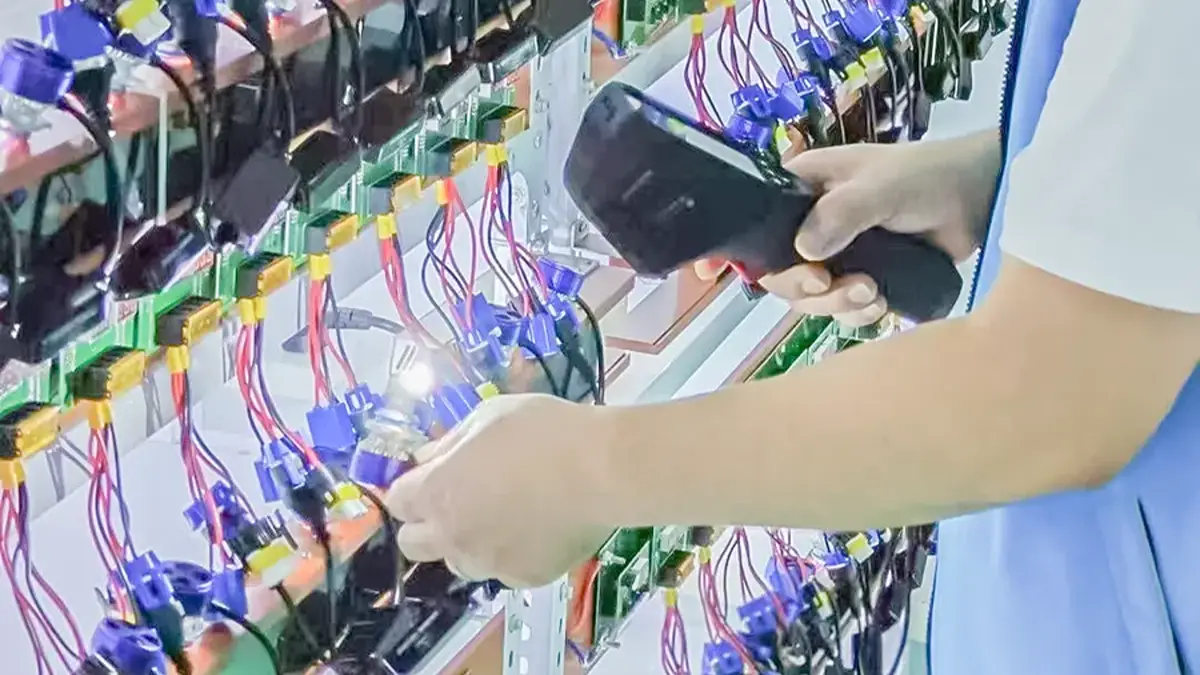
A cold bench, a sealed housing and a long hold give three lumen figures for one module.
A projector lens lives in a closed shell with limited air. The chip puts out less light as its junction gets hot, and a driver that derates on temperature protects it by pulling current back. That protection costs light, which is why a peak figure and a sustained figure are two different claims. Ask what temperature a number was taken at, because a supplier who will not name one has not measured the beam.
Our product pages describe how the modules respond to heat. The H3 page says its temperature control adapts power to the surrounding temperature, and the matrix page describes a built-in mechanism that prevents over-temperature damage. The manufacturing page lists the plant-level hardware behind that: 1 para 8 graphene copper tubes on high-power models, thickened copper substrates, cooling fans and dual-temperature control circuits. Ask which of those sit in the lens you are quoting, because a 45W matrix module and a 130W flagship are not one thermal design.
The driver sits behind the chip, and here a module inherits the record of its factory. Our manufacturing page says the plant makes its own boards on in-house SMT lines and fits dual-circuit switching power supplies. It does not say what the second beam does when one circuit drops, so ask rather than assume. The same page states a 98% CAN bus decode rate and resistance to interference, the complaint a shop hears as a dashboard warning light.
The bi-LED projector lens manufacturer you shortlist should produce a heat-soak record, not only a peak figure. The useful test mounts the module in a housing inside a still-air box at a stated temperature, then compares output at the start with output after a long hold. A factory that owns a temperature chamber can pull that curve from its own records; a trading office has to ask someone else.
Ours lists the equipment behind that claim. Temperature chambers reproduce engine-bay heat, and dual integrating spheres screen incoming chips before verifying lumen output and color on finished goods. Aging racks run constant current through units before packing. Two product tables state an operating range from minus 40 to plus 85 degrees Celsius.
Our guide to what top buyers check at a manufacturer covers those stations in more detail.
Fitment Brackets Decide the Retrofit Outcome
A bulb is a plug standard. A lens module is a bracket, an angle and a bore diameter.
This is where a lens range is won or lost in a workshop, and where a socket list on a carton tells you least. Our car LED bulb line publishes bases from H1 to D8S, including 9005 and 9006. A bulb in one of those bases plugs into a reflector bowl and inherits the aim that bowl was pressed to give.
A lens module has to be held square in a shell designed around a different optical part. Ask a bi-LED projector lens manufacturer which housings it makes brackets for, then read the answer against the published lens table. It names two direct interfaces, an H4 direct-plug family and a short H7 matrix body, alongside size families grouped by diameter. F5 is missing from that table even though the same page lists it as a product, so treat a spec table and a product list as two different documents.
| Published lens group | Socket or size | Power listed | Where a shop fits it |
|---|---|---|---|
| Flagship and direct plug | F3; DJ2, DJ5 and X15P as H4 direct plug | 110W to 130W | Housings already opened for a lens |
| Single and double light cups | 2.5 inch and 3.0 inch bodies | 40W to 100W | Mid-size bores, width from dual cups |
| Matrix lens projectors | 1.5 inch small matrix; 3.0 inch H7 short | 45W and 70W | Tight bores and shallow housings |
| Fog lens projectors | 2.0 inch and 3.0 inch, three-color switching | 60W and 110W | Fog positions and off-road bars |
The bracket itself divides into two schools, and our pages use both words. The lens category page describes a universal non-destructive mounting system that leaves the housing unmodified. The H3 page lists a detachable bracket in lossy and lossless versions, meaning some fits need a drilled shell. A distributor carrying only lossless brackets loses the vehicles where nothing is lossless.
Then aim. The federal standard defines a mechanically aimable headlamp by three pads on the lens that form an aiming plane, used for laboratory testing and for checking vehicle aim. A retrofit module inside a reused shell has no such pads; the adjusters the housing was built with do the work. So a module aligned at the plant can still arrive aimed wrong, because the shell it sits in was never flat. Write the wall check into the fitting instructions you print, and measure the beam in the car rather than the part on a bench.
Which Projector Lenses Carry a DOT Mark
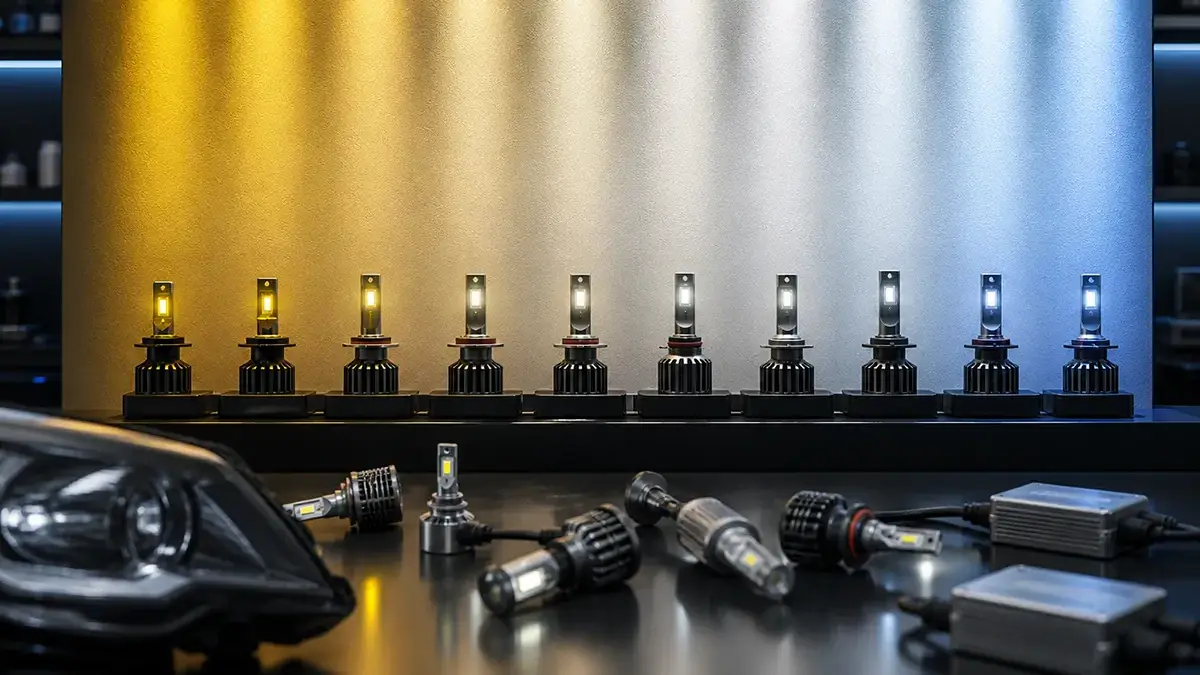
Federal Rule 571.108 puts the DOT mark on the lens, and the maker signs that certification.
Start with where the mark goes, because that settles most supplier conversations. Section 571.108 requires the lens of every original equipment and replacement headlamp to carry the symbol DOT. The same sentence covers every replacement beam contributor, and a lens module is one.
The mark indicates certification under 49 U.S.C. 30115. The section adds one requirement for replacement parts. Each replacement lens also carries the part or trade number of the headlamp it fits, plus the registered name or trademark of its maker.
A certification strip in a PDF is different evidence. The markings above live on the part, and one photograph of a sample lens settles more than a folder of documents.
Understand what the mark proves. Certification under that statute is a declaration the manufacturer makes about its own product. It carries real consequences, but it is not a laboratory approval issued after a regulator cut a sample from your pallet.
Ask any bi-LED projector lens manufacturer for proof and a strip of certification logos usually arrives. An E-mark comes from a different system, so four questions settle it.
- Which authority issued the approval, and which country code sits beside the mark?
- Which regulation series does the document name, and does that series cover a retrofit lens?
- Does the certificate page print the model number you are buying rather than a family name?
- Is the named factory the one shipping your order, or a sister entity?
On our side of the counter, the documents we hold are ISO 9001 for the plant and an R10 approval covering electromagnetic compatibility for one headlight model. Neither one is an optical type approval. So we would rather you read the lens in your hand than take a catalog word for it. A product claim with no model number printed on it describes somebody else’s lamp.
How to Judge a Bi-LED Projector Lens Manufacturer
Order sample sets first, then run six checks before a single carton moves.
Most bi-LED projector lens manufacturers will send samples. Few tell you what to measure, because a spec table flattens the beam, the shutter and the heat curve. Samples are cheap next to a container your market rejects.
| Check | How to run it | What it shows |
|---|---|---|
| Cutoff photo | Module inside a housing, aimed at a wall at a marked distance | Whether the optical claim survives assembly |
| Heat soak | Hold at high beam in a closed shell and compare output | How much quoted output you keep |
| Shutter cycling | Repeat the switch by hand, noting sound, delay and stuck positions | Whether the moving part is the weak part |
| Wattage per beam | Meter at the supply lead on low, then on high | Whether the printed split is real |
| Lens markings | Photograph the markings on a sample lens rather than a datasheet | Whether the part was built to be certified |
| Batch trace | Ask what the code on the shell decodes to | Whether a recall narrows to a date |
Check the unit on every lumen figure before two suppliers sit in one table. Our 2.5 inch page states 5,000 lumens per bulb, while the F5 and F3 pages state 26,000 lumens per pair. Those are two different denominators, so a buyer who compares 5,000 against 26,000 is ranking modules by wording. Doubling the per-bulb figure still leaves the mid-size cup behind the flagship on paper, and only a bench reading settles it.
Then ask which stations a supplier controls itself. A maker that outsources board assembly is slower to explain a driver failure, and a maker without an integrating sphere has no way to defend a lumen claim. Our published process runs six production stages, from material checks through board mounting, machining, soldering, calibration and packing. A separate five-step inspection runs at the handoffs inside that flow, from board testing to a full-load aging run, and passed units get a batch date code before packing.
The commercial terms on our lens page are short enough to quote in a purchase plan. Stock samples leave the same day. A marcação do logotipo a laser começa em 100 sets and custom packaging at 1,000 conjuntos, which the page calls a special low quantity for projector lenses. Pedidos por atacado em massa são enviados em 7 para 10 dias, full OEM branding in 20 para 25 dias, and each product carries a 1 para 2 year factory warranty.
Buy the lens on the cutoff photo and the heat-soak curve. Buy the supplier on the batch code and the aging rack. A range that clears both is a range you can put your own carton on. The branding decision behind it has its own traps, which our OEM and ODM guide walks through.
Send the diameter, the socket and your target quantity. We reply with pricing and sample terms, and sample units ship so you can run the six checks above yourself.
1.5″ to 3.0″ lens sizes | 40W to 130W range | Stock samples ship same day | Quote within 3 horas
Frequently Asked Questions About Projector Lenses
What is a bi-LED projector lens?
It is one optical module that produces both beam patterns from a single LED source. A shield moves across the light path to switch between low and high beam, so no second filament is involved. The assembly holds a reflector cup, a projection lens and the chip as one unit.
Are projector headlights better than LED bulbs?
They control light rather than produce more of it. A bulb in a reflector bowl sends light wherever the bowl was pressed to put it, and a lens gathers the beam and cuts its top. A bulb is faster and cheaper to fit. Where the complaint log is full of glare calls, the lens wins on outcome.
Can I put LED projector lenses in a halogen housing?
That is the normal retrofit route, with three conditions. The diameter has to clear the bore and the dust cap. The bracket has to hold the module square. The beam then needs aiming against a wall, because the shell was designed around a different optical part.
What causes glare after a headlight projector retrofit?
Aim causes a large share of it. A module tilted nose-up lifts the cutoff into oncoming eyes, and a loaded trunk makes that worse. Beyond aim, a lens set at the wrong depth shifts the pattern, and a poor cutoff edge spreads light above the line. Check the wall measurement before blaming the chip.