OEM и ODM светодиодные фары: Какая производственная модель подходит вашему бренду
OEM vs ODM LED headlights is not a branding question. It is a question about who owns three separate things: the drawing, the mold that forms the housing, and the paperwork that lets a lamp clear customs in your market. Two buyers can order the same wattage from the same plant and end up with very different rights.
This guide splits the two models the way a production planner sees them. What each one costs in tooling. What each one costs in calendar time. What it leaves you holding when a supply relationship ends. Every statement about our own plant comes from pages we publish, and both regulatory passages are written against published rule text that we link.
OEM vs ODM LED Headlights In One Paragraph
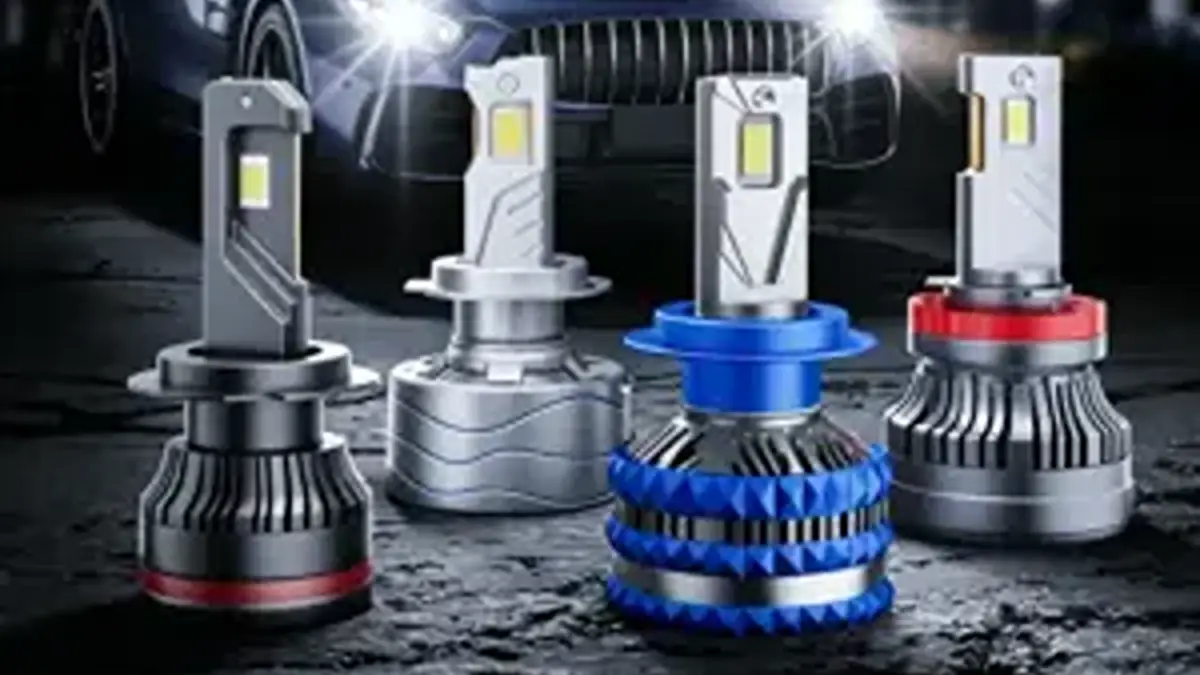
OEM puts your brand on a design the factory already owns, while ODM starts from a brief and changes who holds the tooling.
In the OEM case, the factory already sells a light. You choose a model from a running line, set the color temperature or wattage, add laser engraving on the shell, and put your carton on it. The optical design, the housing shape and the steel that forms them stay the factory’s property. Your contribution is the brand and the specification you asked for.
In the ODM case, engineering works toward a target you set. That target might name a beam pattern, a heat budget, a connector, or a housing that fits one vehicle and holds a shelf position no competitor occupies. Structural and optical work happens before a single bulb exists. We do that work in house, and the housings on our car LED lineup were developed here rather than bought from a tool room somewhere else.
The difference is not quality. It is control. OEM is faster and cheaper because the engineering risk was paid for already. ODM is slower and heavier because someone is buying design hours and steel. The table below reduces the OEM vs ODM LED headlights choice to three rows and one column that matters.
| Model | Who designed the light | Who owns the tooling | Your exposure if supply ends |
|---|---|---|---|
| Private label | Фабрика, on a design already in production | Фабрика | Another seller can carry the identical housing |
| OEM to your specification | Factory base, you set the parameters | Фабрика, unless you funded a change | Re-tooling cost lands on your next order |
| ODM to your brief | Factory R&D working from your target | Negotiated, and yours if you paid for the mold | Transfer rights belong in the contract |
Read the last column before the price. A buyer who compares only unit cost will keep choosing the first row, and will learn at year three that the shape on the box belongs to someone else.
What Each Model Costs You In Tooling
Tooling is the line that divides the two models, because a mold is an asset someone must buy, store and release.
In this product, tooling is not one object. A headlight assembly can need steel for the housing shell, a form for the lens, a fixture for the bracket, and a die for the reflective surface behind the chip. This is where the OEM vs ODM LED headlights difference becomes a bill rather than an argument. The bulb is only what comes out of the steel.
A mold cost does not disappear when the order ends. It sits inside the unit price as an amortized share. Double the run and that share halves, which is the honest reason a small order carries a higher piece price than a large one at the same specification. That is the whole mechanism behind a piece price, and a buyer who sees it stops arguing with a quotation.
Under OEM, no new steel is cut, so no tooling conversation is needed. Under ODM, four questions have written answers before the first deposit moves. Who paid for the mold. Where it sits between orders. Whether it may travel to another plant. Whether the factory keeps the right to sell the same housing to a second brand.
Our published position on the last question is unusual in this category and worth reading twice. The housings in our car line are developed in house, and we state plainly that we do not sell generic market molds to competing brands. That protects the margin of the first buyer. It also means the shape on your carton is the shape we chose, unless you fund your own.
One more warning before any tool is paid for. Verify the plant that will hold your money and your drawing the same way you would verify a factory you had never visited. Our guide to confirming a real factory lists the checks that take an afternoon.
Logo Bulb and Packaging Customization Levels
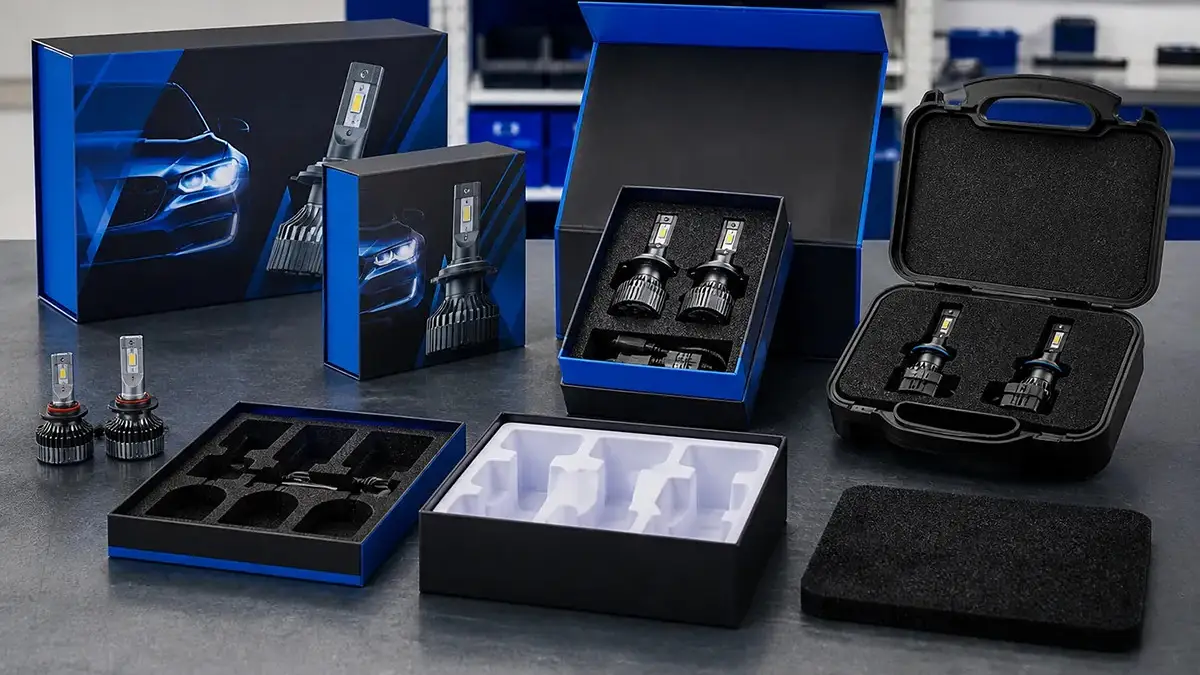
Four kinds of customization cover almost every branding request, and each changes a different asset: the shell, the electronics, or the box.
Buyers arrive with the phrase custom order and mean one of four things. Naming which one saves both sides a week, because each has its own file requirements and its own place in the production queue. The four notes below describe what changes on the product. The table after them is the published ladder of gates, taken from our customization page, and the two lists do not line up one to one. Tuning work can sit inside a logo order, and a mold decision can arrive with a box already designed.
A mark on the hardware
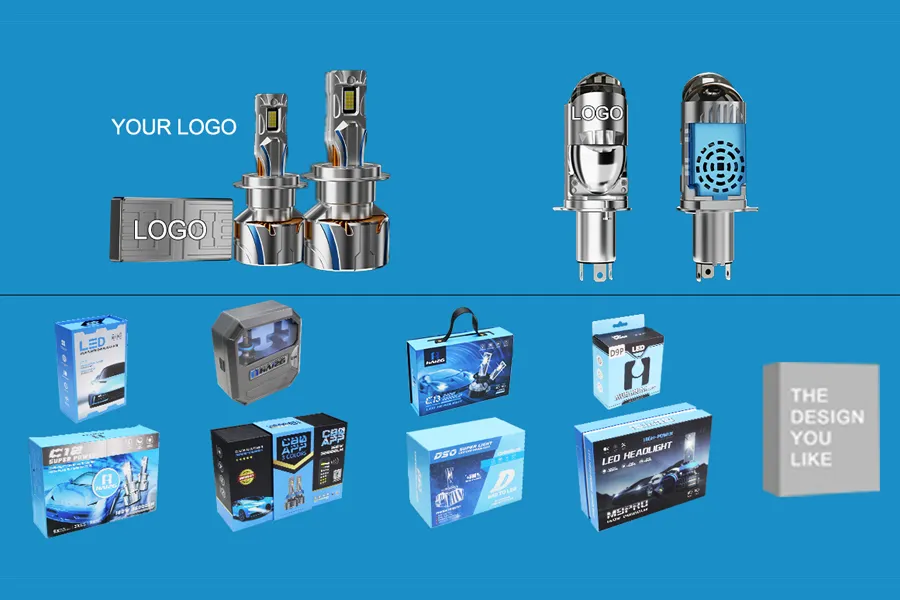
Laser logo engraving goes on the bulb body or the driver box, and the aluminum shell can be painted to a color you choose. Nothing inside the light changes. Supply the artwork as a vector file and ask who pays for a printing plate on the carton, because that charge appears on some quotations and not others.
Electronics and beam behavior
This is where a specification starts to look like a product plan. Wattage is tunable, and CAN bus decoding can be developed for the vehicles your market actually fits. Color temperature covers a range from 2500K to 9000K, with dual-color switching and app control available. The car line spans 50W to 400W, so a buyer can hold one brand across a budget shelf and a premium shelf.
The box you sell from
Branded color boxes, rigid boxes and plastic cases are the difference between a part and a product on a shelf. Our in-house visual team supports packaging design plus the posters and sales sheets a distributor hands to a workshop. This is where an online listing photo starts doing the selling for you.
Structure nobody else holds
Private molds buy you a unique shell and a custom optical distribution. Brackets can be designed to fit a vehicle without cutting it, which matters in markets where installers refuse destructive work. That depth of work runs under NDA, and a bracket is a separate piece of protection from the mold that formed the shell. Fund one and a competitor can still copy the other.
| Level | What changes | Published gate | Who it fits |
|---|---|---|---|
| Standard wholesale | Nothing on the product or the box | Trial quantity quoted per product type | Buyers testing a new line |
| Light OEM | Laser logo on bulb or driver box, shell color | От 100 to 200 sets by category | Distributors starting a branded range |
| Packaging customization | Color boxes, rigid boxes, plastic cases | От 1,000 наборы | Sellers competing on shelf presentation |
| Deep ODM | Private mold, custom optics, exclusive structure | От 2,000 to 3,000 sets under NDA | Brands building an exclusive line |
A trial order sits at the bottom of that ladder with no published number, and that is deliberate. A first-batch gate moves with socket type and stock position. We quote it against your list instead of printing a figure that misleads a buyer planning a different range.
Who Owns The Certifications In Your Market
A certificate names a party, and when that party is not you, the paperwork is a borrowed asset whose renewal you do not control.
This is the part of OEM vs ODM LED headlights that buyers treat as a document exchange and regulators treat as an assignment of responsibility. The marking on the hardware is where the two views meet, because a mark ties a device to a named party.
In the United States, Federal Motor Vehicle Safety Standard 108 covers lamps, reflective devices and associated equipment. Its marking section requires the lens of each original equipment and replacement headlamp, and of each replacement beam contributor, to carry the symbol DOT to indicate certification. Where a ballast is required, the standard lists permanent markings on that ballast, including the name or logo of the ballast manufacturer. Read the sample against that text rather than against a supplier’s brochure.
Country-of-origin marking is a separate duty, and it lands on the importer. 19 CFR Part 134 requires every article of foreign origin, or its container, to show the English name of its country of origin legibly and permanently to the ultimate purchaser. The same part sets an additional duty of 10 percent of the final appraised value when required marking is missing. Your logo on a carton does not replace that marking, and a design that hides it converts a labeling choice into a bill.
For markets that run on type approval, ask three questions of any paper a supplier sends. Which body issued it. Whose name appears as the applicant. Does the address on the file match the plant producing your units. A certificate held by a trading company at an office address tells you very little about the line that will run your order.
Then decide what your own name should carry. Under OEM you are usually listed on the carton while someone else remains the named party on the hardware. Under ODM you are in the position to ask for the opposite. In the United States that request means taking the self-certification duty onto yourself, not only the logo. A buyer who never asks spends the second year importing under someone else’s file.
Lead Times From First Sample To Shelf
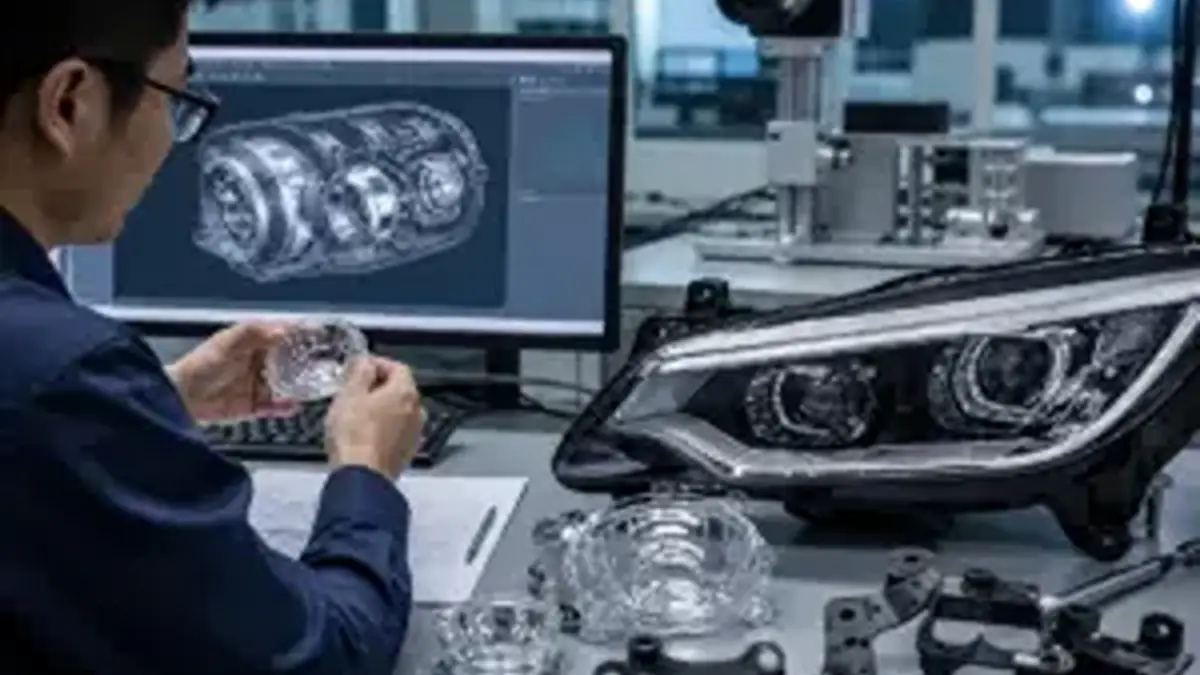
Two clocks decide a launch date: the factory’s own schedule, and the transit plus clearance window that sits outside it.
Our published bands are short and worth memorizing before you negotiate. Stock samples ship the same day. Standard stock bulk orders take about 7 to 10 дни. OEM orders run 20 to 25 дни. A deep ODM project takes 1.5 to 2 месяцы, covering requirement discussion, 3D structure design, prototyping, lab testing, material preparation and mass production.
Those clocks start when the specification freezes, not when an inquiry lands. A sample phase on an ODM file typically runs about one month, because optics, heat and fitment all get tested before anyone signs off. Production is then scheduled for delivery in roughly 15 days after that sign-off. The gap between a buyer’s mental model and these two numbers is where most late launches actually live.
Commercial terms sit on the same calendar. Payment runs 30 percent deposit against 70 percent before shipment, and the delivery term is chosen from EXW, FOB or DDP depending on who books the freight. Ocean transit adds weeks that no factory can compress, so a launch date should be built backwards from the sailing, not forwards from the quotation.
The slowest step in most projects is not a station on our floor. It is the approval of artwork, the confirmation of a Pantone on a printed box, and the reply that settles a bracket drawing. A buyer who returns files inside two days keeps an OEM order at the short end of the band. A buyer who answers in three weeks will blame the factory for the difference.
Building A Private Label Headlight Line
A private label becomes real when three documents exist: your specification, your artwork, and your name on the paperwork the rules require.
Three buyer types hold this space, and each fails in a different way. A regional distributor moving past white-label sourcing wants margin protection and a range nobody else can quote. An online seller wants a listing photo that separates them from forty identical offers and fears a review thread about fitment. A brand with an exclusive line wants optical and structural work nobody else can buy, and fears a supplier who resells the tool.
A private label sits between the two halves of the OEM vs ODM LED headlights question. The engraving is OEM work and takes a week. The rights you want on top of it are ODM questions, and they take a contract. If you are still choosing between factory-direct sourcing and a trader, our breakdown of the four sourcing channels compares what each one hands you at customs.
- Fix the base list before the logo. Sockets, voltage window, wattage, color temperature, vehicle coverage and destination market. A factory cannot misread a document that leaves nothing to infer.
- Pick the level, not the price. Decide which of the four levels buys the protection you actually need. Paying for a mold you could have skipped is the expensive mistake in this category.
- Settle design rights before artwork approval. Mold ownership, storage, transfer rights and resale rights belong in the order, in writing, next to the drawing they describe.
- Put your name where a rule asks for a name. Hardware marking, origin marking and the party who signs the import declaration are three different decisions, and only the first of them is a print job.
- Order the smallest run that tests the shelf. Sell it, read the returns, then plan the repeat at the level you should have chosen on day one.
Take the deeper model only when the shape of the light is itself your differentiator and your repeat orders can carry the tooling. A buyer who tunes wattage and CAN bus decoding for local vehicles learns something real about a market at a fraction of the risk. A buyer who funds a mold before that learning owns a mold and a lesson.
Frequently Asked Questions About Private Label
Can I put my own brand on LED headlights?
Да, and it is the lightest customization a factory offers. Nothing inside the light changes, so the clock is short and the artwork file is the whole setup. Ask two questions before approval: who else already carries this housing, and whether any exclusivity sits in the order rather than in a chat thread.
Who owns the product design in an ODM agreement?
Usually whoever paid for the steel and wrote that down. A plant that tooled at its own cost keeps the housing and can place it with other buyers. If you fund the mold, say so in the order. Then add where the tool sits, whether it may move, and what happens if either side ends the relationship.
Do I need my own certificate to import headlights?
You need paperwork naming the party the rules expect, not always the brand on the box. In the United States the lens carries a DOT marking tied to certification, and origin marking sits with the importer. Ask any supplier for the file, read the applicant name and expiry, and check the address against the plant running your order.
Can a factory match a competitor’s LED bulb design?
Sometimes the honest answer is no. A housing shape can be protected, and a plant that runs its own tool room has little reason to take that risk for a buyer. Ask instead for a design that reaches the same beam and heat targets through your own structure, and let the supplier quote the work.
How long does a private label launch take?
Light branding is weeks rather than months. Artwork approval, engraving and a bulk run of 20 to 25 days cover most of it once the specification freezes. Deep ODM runs 1.5 to 2 months end to end, mass production included, and transit sits on top of that. Build the launch date backwards from both clocks.